

EU AND RUSSIA
With around 130 seats out of 240 in Parliament, Radev secured an absolute majority. This gives him an unprecedented level of political leverage to form a stable government, something not seen for five years in a country affected by chronic instability. Since 2021 Bulgaria has held no fewer than eight parliamentary elections, reflecting a deeply fragmented political system. Turnout slightly below 50 percent remains relatively high for Bulgaria where abstention is usually strong.
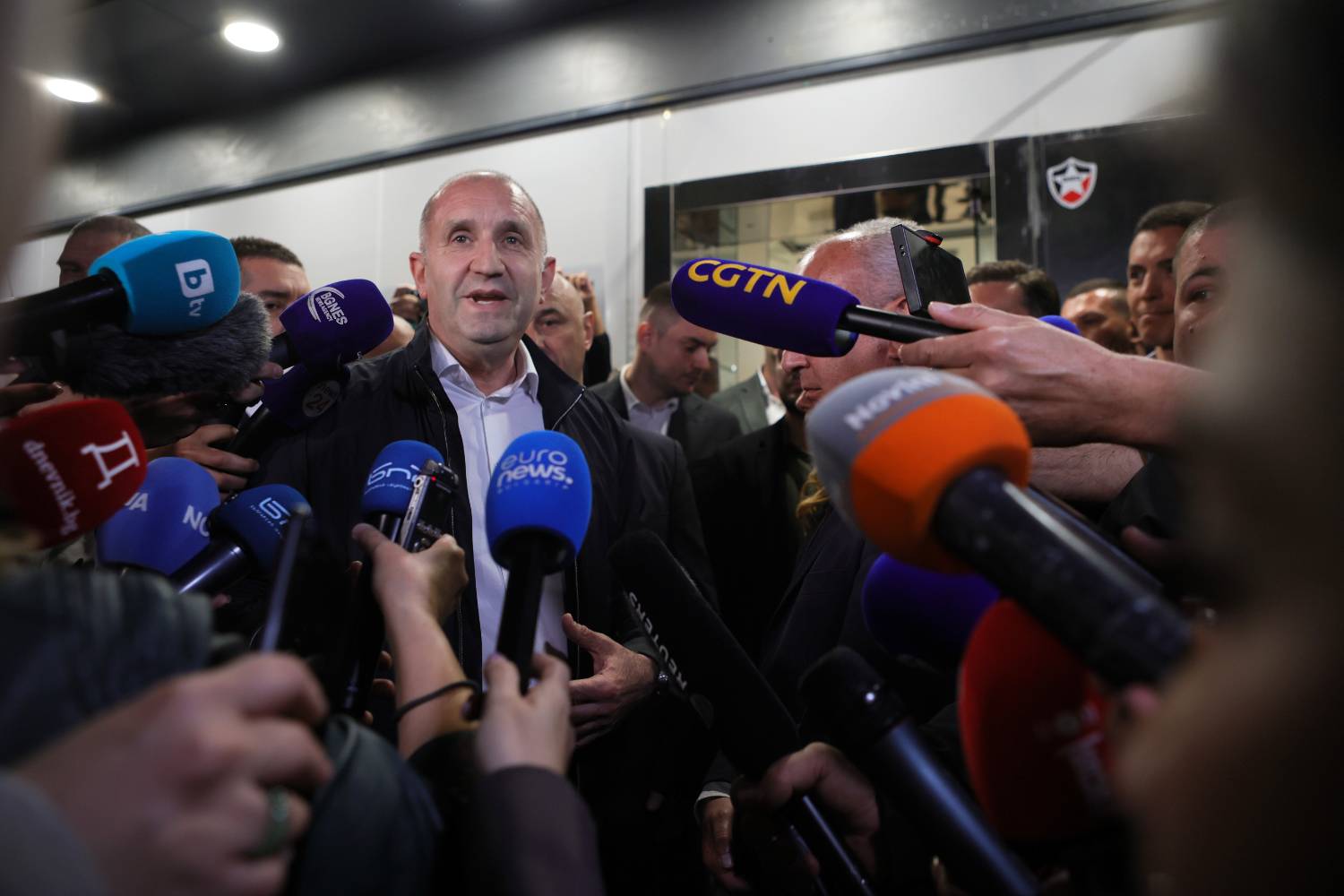
Speaking briefly in Sofia on election night, Radev declared victory and stated that voters had rejected arrogance and complacency from traditional political parties. The 62-year-old former fighter pilot, who served two presidential terms between 2017 and early 2026, is expected to become prime minister in May. His unusual profile combining military discipline and institutional experience strengthens his image as a strong authority figure. However, his past positions on Russia have often raised questions. He notably stated that Crimea is Russian and criticized European sanctions imposed after the outbreak of the war in Ukraine.
Although he comes from the left, he has repeatedly shown political proximity to Viktor Orbán, the Hungarian nationalist leader recently defeated at the polls on April 12. Nevertheless, Radev has always denied any closeness to the Kremlin and has consistently reaffirmed Bulgaria’s membership in the European Union. His campaign focused mainly on the fight against oligarchy, a particularly powerful theme in a country marked by repeated corruption scandals. In December 2025 large anti-corruption protests led to the fall of the conservative government in power.
GIVING UP PRESIDENCY
It was in this context of political unrest that he announced in January his resignation from the presidency in order to run in the legislative elections at the head of a new movement called Progressive Bulgaria. This strategic move reflects the central importance of the prime minister position in Bulgaria which holds far more power than the presidency. During his campaign he promised deep reforms of the judicial system, especially through the creation of a functioning judicial council in a country where justice is widely seen as corrupted and weakened by political divisions.
On election night Radev stated that Bulgaria would continue its European path while calling for more pragmatism and critical thinking regarding relations with Russia. This nuanced and sometimes ambiguous stance is a recurring feature of his political communication. He also supported the idea of renewed dialogue with Moscow on energy issues, referring to an approach he claims is similar to that of Emmanuel Macron who has also advocated for renewed dialogue.
Within his entourage some officials sought to reassure public opinion. Slavi Vassilev one of his close allies stressed that Bulgarians do not want rapprochement with Russia but rather continuity within the country’s strategic alliances including NATO and the European Union. These statements clearly aim to calm international concerns, especially as Bulgaria plays an important role in supplying ammunition to Ukraine.
During his presidency Radev occasionally signalled to pro-Russian sentiment that has existed in Bulgaria since the late nineteenth century but never challenged the country’s pro-European orientation as a member of the EU since 2007. One notable exception occurred in 2025 when he supported at the last moment the idea of a referendum on adopting the euro. This proposal was rejected by the then conservative government but Bulgaria eventually joined the eurozone smoothly at the beginning of 2026. This episode highlights ongoing tensions around economic and monetary sovereignty.
After several years of fragile and short-lived governments Bulgarians are now hoping for stability. Radev’s profile as a former head of state is seen as reassuring especially in rural areas where inflation remains the main concern along with the effects of the war in Ukraine and the adoption of the euro. Purchasing power remains the central issue driving voter behaviour.
His moderate position on Russia allowed him to attract part of the electorate from the pro-Russian nationalist Renaissance party whose support collapsed to around four percent. His coalition also weakened the conservative GERB party of former prime minister Boiko Borissov which came second with only 13.4 percent of the vote its worst result ever. This decline reflects the weakening of traditional political forces.
Just behind them the pro-European centrist party We Continue the Change obtained around 12.6 percent confirming a downward trend since its participation in government between 2021 and 2022. Despite their strong criticism of Moscow, they could potentially cooperate with Radev to help him reach a constitutional majority of 160 seats necessary for deep judicial reform. Such cooperation would open the door to major institutional transformation.
Finally, the party of oligarch Delyan Peevski sanctioned by the United States since 2021 for corruption also declined receiving around 7.8 percent of the vote. This confirms that a shift toward a strongly pro- Russian line similar to Hungary is not currently on the agenda in Bulgaria. In Sofia the main question on election night was whether Radev would obtain enough support to amend the Constitution and reform a widely criticized judicial system. This will be the key test of the credibility of his future government.
*Author is a former member of the UN senior staff