


Most famous for his 2021 exhibit “I Miss You so Much” displaying lost human limbs, Khaled Hussein, who documents the war with sculptures of clay, continues to sculpt in the middle of the ruins of Gaza, records his works, then destroys them. He explains why to “Novi Magazin”.
You were born in Rafah, in Gaza, where you studied art at the Al Aqsa University. Can you tell us about its art department?
I was born in Rafah in 1975. In 1993, I finished high school. At the time, there was no university offering a fine arts program in Gaza. But in 1996, the Department of Art Education opened with limited resources at the Al-Aqsa University. I joined the first cohort of 15 male and 22 female students in this program, graduating in 1999. These years of studies and the camaraderie with fellow students were my best years.
Your art was exhibited widely throughout the Palestinian territories. How about internationally? Have you been able to sell your work?
I participated in numerous local exhibitions in Gaza and the West Bank with oil paintings. However, transporting my sculptures outside of Gaza proved difficult. My works were shown at several international exhibitions in Turkey, Bosnia and Herzegovina, Greece, Germany and the United States, but only through photographs.

You are mostly known for your sculptures linked to the Great Return March of 2018. Can you tell us about that?
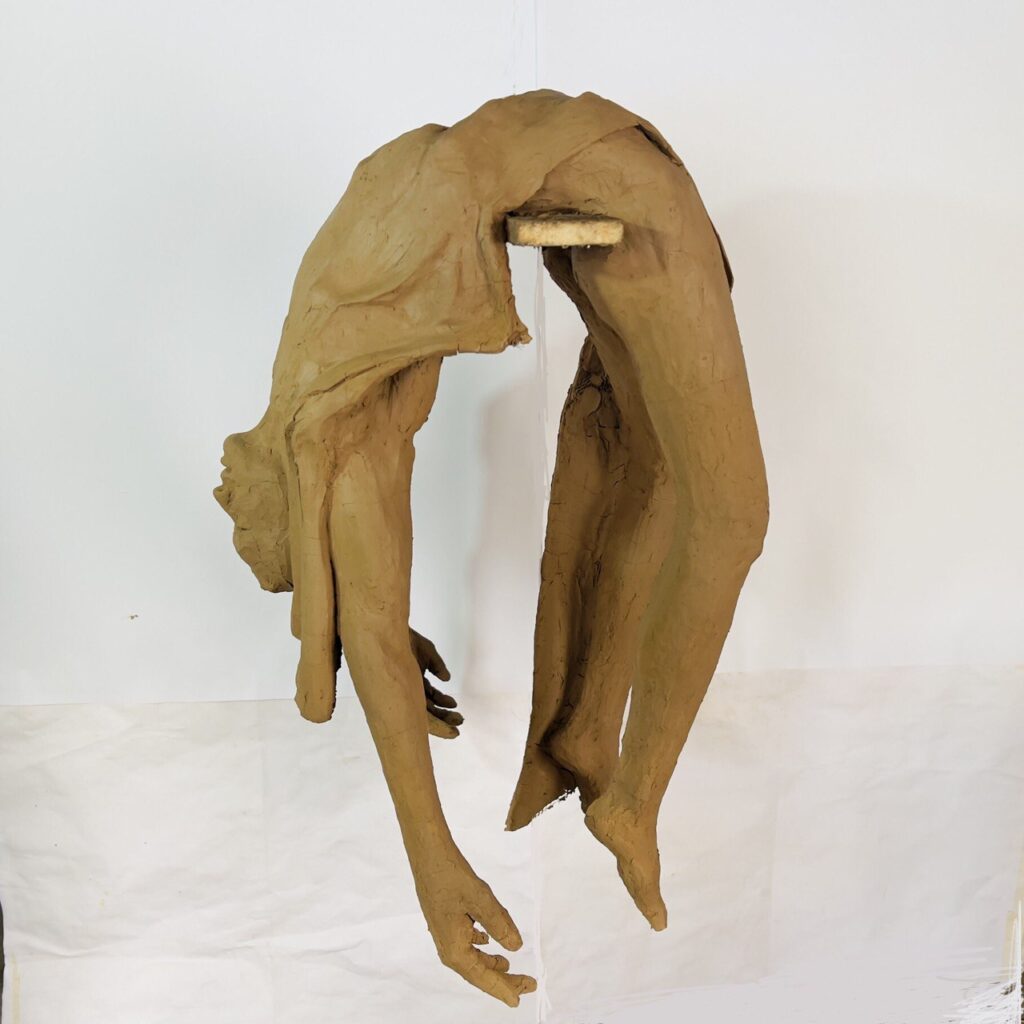
In 2021, I showcased a solo exhibition titled “I Miss You So Much,” which served as an introduction to the research I was conducting at the Shababeek Gallery in Gaza City. Through this project, I attempted to express the initial shock, thoughts, and feelings of young amputees, particularly those who lost limbs during war and conflict, especially during the Great March of Return protests on the Gaza border in Palestine. The Great March of Return was a series of peaceful popular protests that began in Gaza on March 30, 2018, coinciding with Land Day of 1976, when Palestinians in the Galilee protested against land grabs by the state of Israel. Demonstrators at the Great March of Return demanded the right of return for displaced Palestinians and the end of the Israeli blockade of Gaza. The protests, which included sit-ins along the Gaza-Israel border, continued for months. Israeli forces fired on the protesters, particularly targeting the limbs of young people, deliberately injuring and maiming them. I also sought to understand the anxieties and priorities of these victims and to embody their psychological suffering. My artistic project explores the state of loss, alienation, escape, and withdrawal—the physical and psychological suffering of amputees, especially given the lack of psychological and therapeutic support available to them—both within society and within the family. This is achieved through the art of sculpture, given its powerful and impactful visual effect.

Most of your work was destroyed recently. How did that happen?
In May 2024, I was displaced from my home when the occupation forces attacked Rafah. I left everything behind, hoping to return soon. It was only after eight months of displacement that we were finally allowed to return to Rafah during the first ceasefire in February 2025. I went to check on my house, I was so shocked by what I saw that I couldn’t even locate it at first. It was just a pile of rubble. As a result, I lost all my artwork.
You became a displaced person in Gaza. But you are sculpting again. What materials are you using?
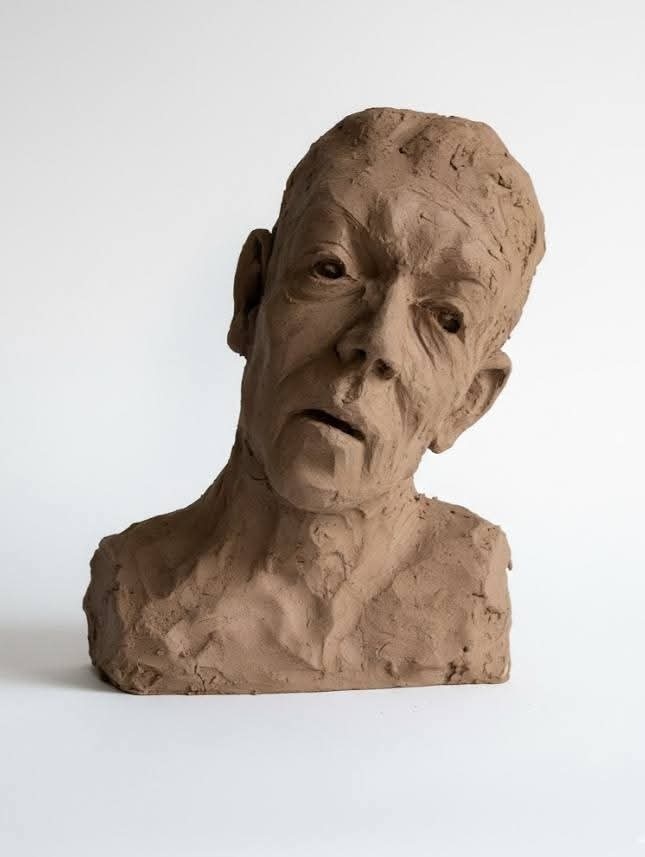
In Gaza, nothing is permanent, so I began to feel that art shares the same fate as its people do. The idea of loss has become part of our daily lives. For me, art has become more about psychological resilience than anything else. Under the siege and with limited resources, after being displaced for a second time to Deir al-Balah, clay was the closest and most readily available material. But my relationship with it was no longer purely technical, because I sometimes used clay taken from destroyed places and from among the rubble. I felt that this material carried the memory of the homes, the people, and the lives that had passed through there. Therefore, clay was no longer just a material for sculpting; it became a witness to the war, bearing the mark of both place and people. Using this material is an attempt to preserve the human memory of war, to preserve the features of those whose lives were uprooted, and to maintain or restore to human memory what wars try to erase.

Why have you chosen to destroy the works you are creating now? Can you tell us about this process?
After my home and artwork were destroyed in the war, and after repeated displacements, I began to see art differently. I no longer think much about how long a piece of art will last. I destroy my art work myself, before the machinery of war and the bombings do so. This isn’t out of despair, but because the idea of loss has become part of our lives. As I mentioned before, nothing is permanent; I might leave at any moment and be displaced again. Losing a piece of art isn’t the end: the loss becomes an extension of its meaning and a direct reflection of human fragility amidst this devastation. I am filming my current art project from multiple angles and creating 3D models of some scenes, hoping to share them internationally, even though the works physically no longer exist.
Mr. Hussein has not answered any questions addressed to him on the subject of peace. His silence is immense. Maybe a reflection of the depth of the pain he expresses through his works of art.
More of Hussein Khaled’s artwork can be found here: https://www.facebook.com/share/18w69WkjLU/ and here: https://www.instagram.com/khaled.hussein75?stkn=YW14ZjV4d24zamMy