

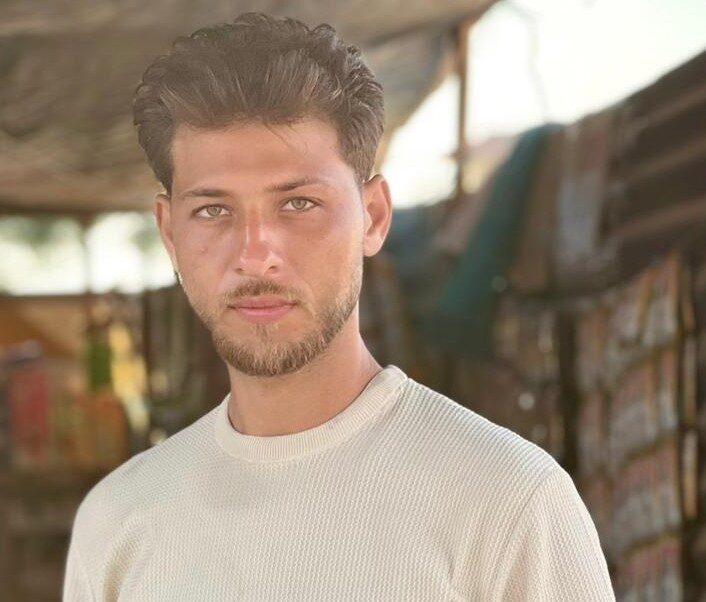
Ahmed Alhalabi, born in Gaza in 2003, is among the Gazan artists, who, despite the hardships, continue to create. “Through my art, I am saying that Palestinians are human beings just like everyone else. I want my paintings to tell the world not only about the suffering I experienced, but also that I continue to believe in the value of every life and in peace.” says “Novi Magazin’s” interlocutor at the beginning of this conversation.
What was your life like before October 2023?
Before October 2023, my life was simple but active. I was studying multimedia at the Al-Aqsa University in Gaza. I focused on portrait drawing and painting. I participated in a wide range of art activities. It wasn’t ideal. The Israeli blockade of Gaza affected many parts of our lives. It made travel very difficult, limiting opportunities for further education, professional development, exhibitions abroad, and obtaining art materials from outside Gaza. Despite these difficulties, I was still able to study, work, create art in my own space, and plan my future in which art would be my source of income.
How has your life changed since October 2023?
Almost everything has changed. We went from a relatively normal life to one filled with fear, displacement, destruction, and the loss of loved ones. Access to food, water, electricity, and other basic necessities became grueling. The majority of us, including myself, are now living in tents. I lost many of my art supplies that I depended on for my work. Losing my art supplies had a very deep effect on me. There were periods when I couldn’t draw or paint anymore at all. For an artist, losing the tools he uses to express himself is like experiencing losing his ability to speak. Suddenly not being able to paint made me feel that a significant part of my life had been taken away from me. When some materials do become available, I use them as carefully as possible. Some of my artworks survived, but many of them were destroyed, damaged, or became inaccessible because of displacement. This is very painful because my artworks are not simply objects. They represent years of work, memories, and a meaningful part of my identity.
Your works were exhibited abroad. Can you tell us about that?
One of the most beautiful experiences for me has been for my artworks to be seen by people beyond Gaza. This year digital versions of my works were exhibited at Reba Place Church in Evanston, Illinois, in the US. Even if I cannot do so, our stories and voices are crossing borders. I feel proud when people see Palestinian art not only as something connected to war and destruction, but as art that also carries emotions, identity, humanity, beauty, and hope.
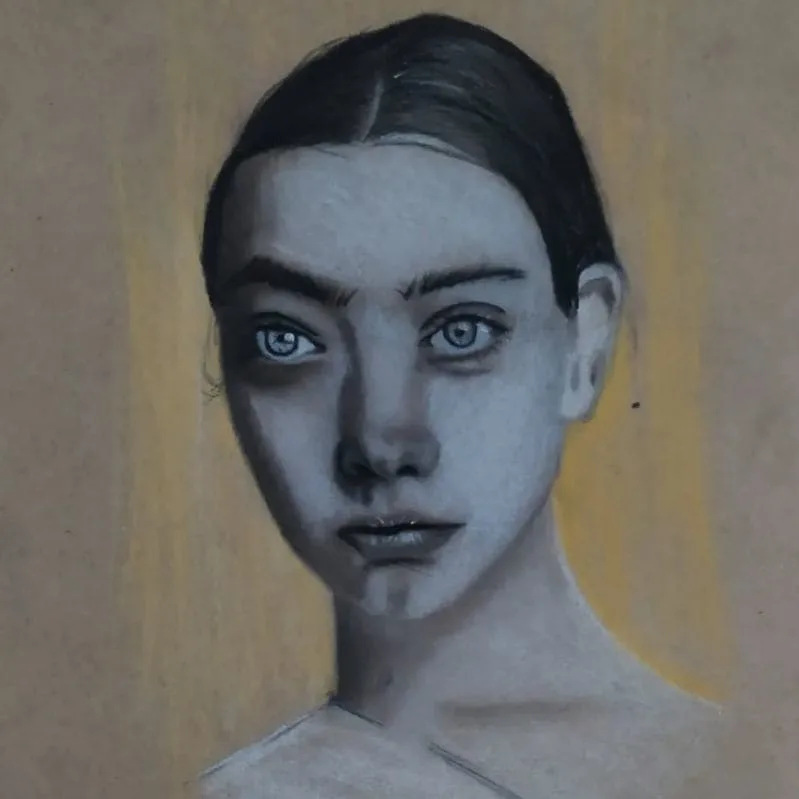
What made you decide to continue painting regardless of the immense hardships in Gaza?
At first, it was extremely difficult to think about art in the middle of all this pain. There were moments when survival itself was the only thing I could think about. But I realized that painting is what makes me feel that I am still alive and able to express myself. What’s more, when I paint, I can say things that I cannot always express with words. I also wanted to show the world that Palestinian artists are still here. Gaza is not only images of destruction. It is also a place where people dream, create in a variety of ways, and try to preserve their humanity despite everything. Art has become a way of maintaining hope, memory and identity. Continuing to paint is my way of refusing to let the war take away the part of me that creates and dreams.
Where do the materials you need to paint come from?
Under the current circumstances in Gaza, obtaining art supplies has become extremely difficult. I depend on whatever materials I can find locally. I cannot always know the source of the material sold locally. Materials are scarce and expensive. I have learned to work with alternative options of paper, pencils, paints, cardboard. I reuse materials, and change my technique according to the materials I have. Improvising with the supplies allows me to continue creating instead of stopping completely.
You and your brother painted a mural of Lamine Yamal, a very prominent football player, who played for the Spanish national team that won the FIFA World Cup in 2026. What is the meaning of this mural?
The mural was more than simply a painting of a football player. For many young people, Lamine Yamal represents dreams, ambition, talent, and the possibility of achieving something great despite being young. We wanted the mural to remind young people in Gaza that even the most difficult circumstances should not destroy their ambitions or make them stop dreaming. The mural also conveys our appreciation for Lamine Yamal’s public expressions of support for Palestinians, it is a way to thank him for it.

Tell us about your self-portrait depicting you wearing a keffiyeh with a white dove resting on it.
The white dove holding an olive branch in its beak is a symbol of peace and hope, while the keffiyeh represents my Palestinian identity, heritage, and connection to my homeland. The artwork is a message from someone who has experienced violence and wants peace, so that we could live in freedom, a normal life like other people in the world. I hope this message reaches Palestinians, Israelis, and people around the world. I hope that political decisions will be made to end the suffering and create a path toward a just and lasting peace.
What is your response to those who say that all Palestinians are potentially dangerous and terrorists?
I reject the idea of judging an entire people as dangerous or terrorists. Is being Palestinian evidence that someone is dangerous? Palestinians are millions of different individuals with different lives, personalities, professions, dreams, and experiences who simply want to live in security and with dignity. Every life has value. Palestinian lives are not more valuable than that of Israelis and Israeli lives are not more valuable than that of Palestinians. I dream for us all to live in peace, freedom and justice.
Digital copies of your works are available for sale online. Have there been purchases? Who are the buyers, and what do you do with the proceeds?
People from the United States, Japan, France, and other countries have purchased digital copies of my artworks. People have also contacted to commission specific paintings. They are not simply buying a painting. They are supporting me as an artist and helping my story and my work reach people beyond Gaza. I am grateful to them. Given the current circumstances, I use the proceeds primarily to help cover basic needs for my family; with what may remain, I purchase whatever art supplies I can find.

How do you see the future?
Despite everything I have been through, I am still trying to hold on to hope. At this moment, I feel that my future as an artist needs a new opportunity outside Gaza. I dream of being able to leave Gaza, travel to Serbia or another European country, where I can live safely, continue my studies, develop my skills, and career and participate in international exhibitions and art projects. Yet, I will not abandon Palestine nor my identity. I want to carry my story and my art with me to the world. However, if there is genuine and lasting peace, security, and an opportunity to rebuild, I would want to stay, because Gaza is my home.
You use the word “humanity”. What does this word mean to you?
Humanity means remembering that behind every number, photograph, news report or political argument, there is a human being with a family, memories, fears, dreams, and the right to live. Humanity means being able to see another person’s suffering even when that person is from a different background, nationality, or political view. Through my art, I am saying that Palestinians are human beings just like everyone else. I want my paintings to tell the world not only about the suffering I experienced, but also that I continue to believe in the value of all life and in peace.
For those who are interested, Ahmed Alhalabi’s works can be seen and ordered at: www.instagram.com/art_