

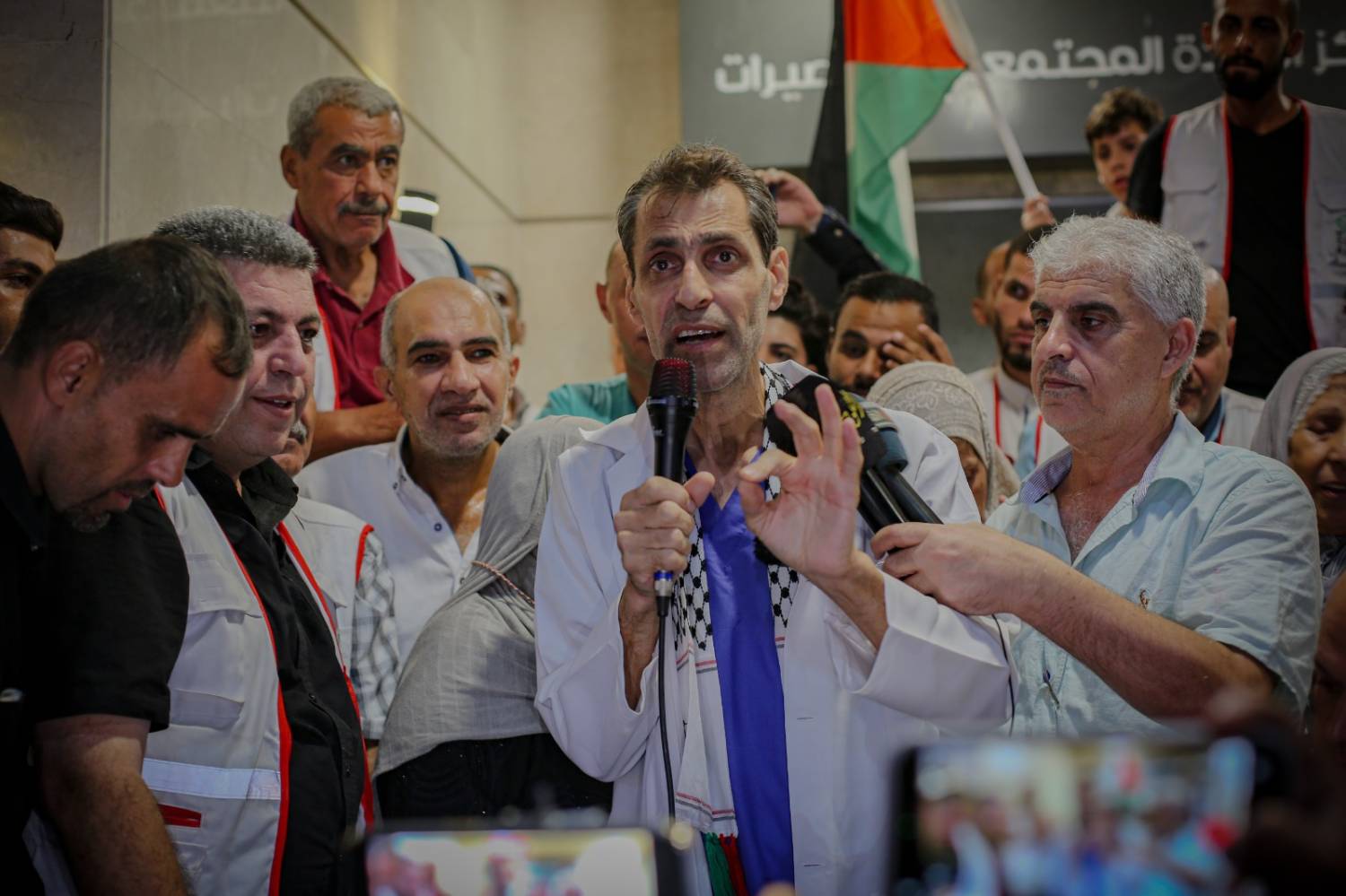
Can you describe your work before October 7th, 2023?
Yes, I studied medicine in St. Petersburg, like many Palestinians who studied in Russia in the 1990s, the academic standards were strong. I returned to Gaza City and worked in Jabalia, a refugee camp in Gaza since 1948. I have been working there for 24 years, first as an anesthesiologist for the 80 bed Al Awda hospital, a non-governmental, not-for-profit hospital. I became its director in 2018. Like all hospitals in the Gaza strip, we suffered from shortages of medication and some equipment due to the siege imposed on Gaza by Israel for more than 17 years. The other challenge concerned paying the salaries of the hospital‘s employees and covering its running costs because Al Awda is not a governmental institution, but an NGO. We had a contract with UNWRA, the UN agency for the protection of Palestinian refugees, our main donor. They paid for the medical services provided to Palestinian refugees in Jabalia.
What changed after October 7th, 2023?
The hospital was first attacked by the IDF in November 2023, three doctors were killed, 2 nurses were severely injured, 1 hygienist was totally burned and 1 civilian also died. Later, 2 more staff were killed by a drone, in total we lost 6 staff. The material damage to the hospital was significant, the ceiling collapsed, the central air conditioning and water tanks were damaged and glass shattered everywhere. This was one month before my arrest. It was terrible. I continued working in the hospital until my arrest on 23 December 2023.
Can you describe the circumstances of your arrest and your detention?
One ambulance driver, 1 nurse, 1 security staff and myself were arrested together. We were taken to the Sde Teiman prison. The first three weeks of my incarceration were the hardest. The food was substandard, there was no medical care. We were forced to sit on our knees for more than twelve consecutive hours, handcuffed and blindfolded. We were blindfolded most of the time. I was then transferred to the Ketziot prison in the Negev desert, where I spent 1 year and 7 months. This was a bit better, we could at least walk for an hour a day. From there I was transferred to yet another prison where I spent 4 months before my release on October 14th, 2025, as part of the agreement for the exchange of captives brokered between the parties.
The conditions in the prisons were harsh. Overcrowded cells, terrible sanitation conditions, no changing of clothes, no soap, no shampoo, I caught scabies. I also suffered from constant headaches and stomach problems caused by spoiled food and lack of clean water. Food was also inadequate in terms of quantity and nutritious value. The overcrowded and unsanitary conditions led to frequent colds and various skin infections among the prisoners. There was deliberate psychological pressure. An example of psychological pressure was the constant interrogations, even about things to which I had no connection, and there were threats. They would keep the lights on all night, preventing us from sleeping properly, and sometimes isolate prisoners for long periods to break their spirit. The treatment of prisoners was often degrading, we were being forced to stand for hours during inspections, we were being shouted at and insulted for no reason. The goal was to make us feel powerless and humiliated. We were subjected to continuous surveillance and communication was restricted. Despite all this, the time there strengthened my resilience and deepened my understanding of injustice and human dignity.

What was the reason for your arrest?
The Israeli army said that I refused to evacuate the hospital; that we were shielding and treating armed Palestinian militants. Nobody carrying arms is allowed in our hospital. They asked about tunnels under the hospital. There are no tunnels under the hospital, only around it.
While in prison did you know what was going on in Gaza?
Unfortunately, no, there was a complete blackout, any information we received came only from the newly arrived prisoners.
What were the other prisoners accused of?
Most of the other prisoners were accused of political activities, such as participating in demonstrations, expressing opinions against the occupation, or being involved in student or community organizations. Some were detained without clear charges under administrative detention, based only on suspicion or alleged security reasons.
What was your relationship with Hamas before October 7th, 2023?
Absolutely no relationship. There has never been any relationship between Al-Awda Hospital and any political faction or armed group, either before or after October 2023. The hospital has always been an independent medical institution dedicated to providing healthcare to all patients without discrimination or concern for political affiliation. The Al Awad hospital did however operate with a license from the Gazan Ministry of Health. In Gaza, it is difficult to be completely isolated from the political reality, as different authorities influence many aspects of life. Nevertheless, it is entirely possible for individuals and institutions to have no organizational or political connection to any group, focusing solely on their work.
What did you think of the Hamas October 7th attack on Israel?
I was not happy about it.
Can you say why?
I didn’t see any reason for this attack.

Many justify the reason as being 70 years of occupation and injustice -can you comment on that?
I know that very well, and the whole world knows that we have been mistreated and suffered injustice for almost 80 years. However, the timing was strange. On the one hand, because the people of Gaza suffered greatly from consecutive wars and, on the other, the situation had just begun to stabilize, the health sector was being reorganised, efforts were undertaken to improve medical services regardless of limited resources, and despite the harsh siege that has been lasting for more than 17 years and the power cuts lasting more than 16 hours a day.
Can you describe your release from prison, your return to Gaza, and what you found there?
I felt overwhelming joy the moment I met the Red Cross delegation, I realized then that the reunion with my loved ones was near. However, even during our release, the Israeli army continued to use violence, they beat us, and humiliated us. But all of that pain disappeared the moment I met my family and friends. The worst part was when I saw Gaza completely destroyed -I could never have imagined such devastation. I felt a deep sense of disappointment, and I am still suffering from psychological distress and health problems.
Who do you blame for the devastation?
I hold the Israeli occupation responsible for the devastation. Since 2007, Israel‘s continuous wars, bombings, and its blockade of Gaza have caused massive destruction and deep suffering to the people of Gaza. At the same time, I also believe that the international community, more exactly its leaders bear responsibility for only paying lip service, while failing to protect civilians or hold anyone accountable.
You started working very shortly after you release. The Al Awda hospital is mostly destroyed and closed by order of the IDF since May 2025. What does your work consist of now?
Yes, I returned to work shortly after my release. Al Awda Hospital is still closed due to the extensive damage it suffered during the war. Since then, I have been working with a medical relief team, it comprises staff of the Al Awda Hospital, including doctors, nurses, and paramedics. They all volunteer to continue their humanitarian work despite the difficult circumstances. The team provides healthcare services to displaced families and injured civilians in temporary makeshift clinics and in shelters. Our work mainly focuses on emergency care, maternal health, and psychological support for those affected by the conflict. There is another non-governmental-non-profit hospital in Nuseirat, central Gaza, which is partially functional. It operates with very limited resources, equipment and medications. The shortage of fuel has made it extremely hard to maintain regular medical services.

What are the challenges as compared to before October 2023?
Compared to before October 2023, the challenges are much greater -the number of injured and displaced people has increased dramatically, there are cases of acute malnutrition, especially among children and patients with chronic diseases due to severe shortages of food and medicine. Hunger is widespread, the humanitarian situation continues to deteriorate. The working conditions are exhausting both physically and psychologically.
What is next for you professionally?
I have been asked to lead three programs: two hospitals and one primary health care program comprising 6 primary health care centers.
Where do you get your medical supplies from at this time?
Medical supplies used to be purchased from local companies and obtained as donations from our partners. Most local companies from which we purchased materials have stopped operating or are functioning at a very limited capacity due to destruction, lack of fuel, and shortages of raw materials.
If you were offered a job abroad, would you leave Gaza with your family?
I will send my family to Egypt for 1 year. But I am staying in Gaza to work.
Israel is asking for Hamas to disarm: do you think Hamas should do that in order for Israel to withdraw from Gaza and the so-called cease fire evolve into peace? Do you trust Israel in that regard?
This is purely a political question.
Yes, do you have an opinion about this? What do you think is possible now after the almost total obliteration of Gaza by Israel?
I have no clear vision considering the ongoing political instability. All I want is the reconstruction of Gaza and to live in peace and tranquility.
Israeli leaders have openly stated that their wish is to empty Gaza as much as possible of its Palestinian population -what is your response to that?
I apologize for not answering, I prefer not to go into political details.