

It happens that certain sentences pronounced by military actors crystallize, in a few words, what months of silent evolution had already made inevitable.
The statement by General Eyal Zamir, in December 2025, describing the line that now cuts Gaza into two zones as a “new border”, undeniably belongs to this category.
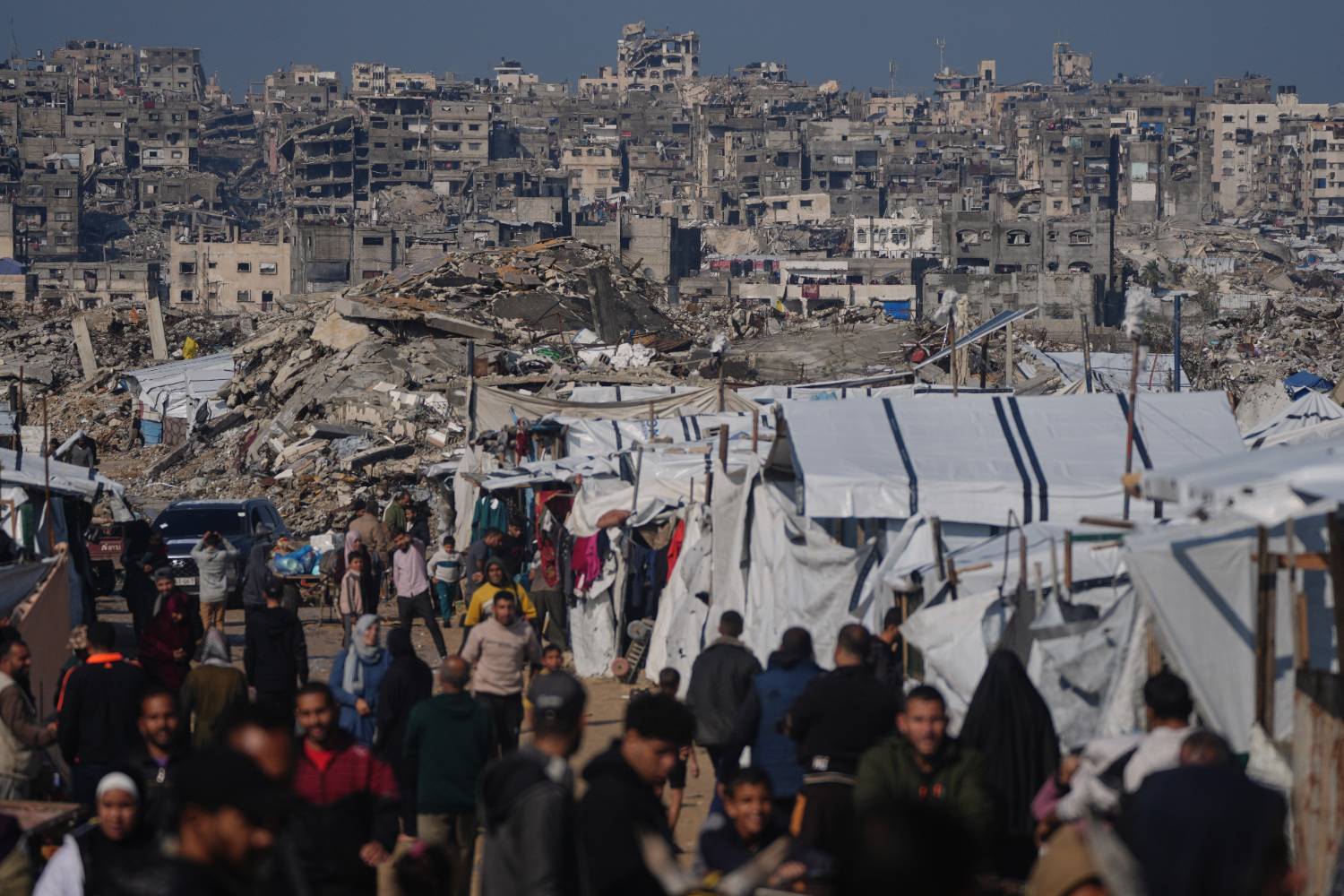
This line, drawn at the beginning as a simple ceasefire device pending the second phase of the US President Donald Trump’s plan, is becoming something else: a mechanism of territorialization, an infrastructure of separation, a space of fragmented sovereignty.
It possesses neither legal status nor international recognition, but it imposes very concrete effects: it controls flows, slows humanitarian aid, organizes daily life, and gradually redraws the mental and political map of Gaza.
The first phase of the plan, launched in Sharm el Sheikh, had given the illusion of a possible dynamic: release of hostages, return of bodies, prisoner exchanges, entry of a limited volume of aid. But the second phase, international force, progressive disarmament of Hamas, Palestinian technocratic committee, American supervision, collided with an immovable reality.
Israel refuses any architecture that would strengthen the Palestinian Authority.
Hamas accommodates itself to a status quo that guarantees its local control.
Arab states hesitate to invest in a solution over which they control neither the contours nor the risks.
The result is classic in prolonged conflicts: the provisional structures itself, solidifies, settles. This process, well known to analysts, has a name: the consolidation of the temporary. What was supposed to be only a parenthesis becomes a durable condition, what was supposed to prepare peace ends up reorganizing war.
The exiles of Hamas
Several hundred kilometers away, in the Egyptian hotels where they have been accommodated since the October 2023 truce, the leaders of Hamas are living a strange, almost surreal experience: that of an exile without refuge and a power without territory.
Among the 154 exiles, only 18 still exercise a theoretical political influence. In practice, their capacity for action is reduced to the extreme. Gaza, now structured by its military commanders entrenched in the tunnels, escapes their authority. Decisions are made on the ground, at the rhythm of operational contingencies and the immediate necessities of survival. In this uncertain exile, vulnerability is permanent.
Israel reminded this unambiguously: in December 2023, Ronen Bar announced that the leaders of Hamas would be “eliminated wherever they are”. The following months proved him right. Saleh Al Arouri is killed in Beirut, Ismail Haniyeh falls in Tehran, a strike in Doha decimates part of the political bureau.
These eliminations have a structural effect: they close the doors of states likely to host the Hamas leadership durably. Algeria hesitates, Southeast Asia refuses, China turns away. Exile becomes a shifting space, a geography of uncertainty where each movement can be fatal.
This phenomenon is not unprecedented in the movement’s history.
Hamas has known the camps of Lebanon, Jordanian exile, the Syrian interlude, the Qatari Turkish Iranian dispersion. But never had the leadership been so dispersed, so monitored, so deterritorialized. Today’s exile offers neither sanctuary, nor strategic depth, nor space for reconstitution. It produces only an ideological survival, a role of representation emptied of substance, a voice without a hold on the reality on the ground.
Crisis that echoes past political diasporas
Palestinian history, and more broadly the history of politico military movements, is marked by experiences of successive exiles.
Those of the PLO in Tunis, of Fatah in Lebanon, or of Hamas between Amman and Damascus, all show the same tension: a movement removed from its territory gradually loses its capacity to represent those in whose name it speaks.
Today’s Hamas is exactly in this situation.
Without a stable territorial base, entirely dependent on the goodwill of hesitant host countries, monitored by Israeli intelligence and threatened by targeted strikes, the exiled leadership embodies more a memory of the movement than an active political force.
Historical trajectories help to understand this moment: in the nineteen nineties, Hezbollah could provide Hamas with ideological and military support; in the two thousands, Syria served as a strategic sanctuary; in the two thousand tens, Qatar played the role of diplomatic intermediary. Today, none of these spaces fully fulfils its function.
Hamas evolves in geopolitics of closure, a sort of political diaspora under pressure, where each country offers only a temporary, reversible, controlled welcome.
Gaza without governance: internal militarization and the erasure of politics.
While the exiled leaders struggle within a hostile geography, Gaza undergoes a profound transformation: the total militarization of its governance.
The political structures of Hamas have faded in favour of military commands, whose anchoring in underground tunnels constitutes the perfect metaphor: an invisible, fragmented power, reduced to tactical survival, detached from any structured political projection.
This evolution has four major consequences: on politics – Hamas no longer has any real capacity for negotiation; its exiled leadership cannot commit the military wing, the military wing cannot conduct a political process. Mediation becomes an abstract exercise without a reliable interlocutor; on the territory – the division of Gaza into two zones is not only a security device, it is a territorial recomposition. Each day, the line imposes a new geography, tightens spaces, reorganizes priorities, and ends up drawing a new material framework for Palestinian existence; on the humanitarian level – aid circulates drop by drop. It keeps the population alive but in a state of total dependence, a kind of administered survival that offers no prospect of reconstruction; on the movement itself – Hamas becomes a duplicated structure: an opaque autonomous military core in Gaza and an ideological shell in exile, deprived of means of action.
One moves then from an integrated politico military movement to a constellation of fragmented actors, sometimes in competition.

What endures: the regime of the provisional
Through these transformations, a common horizon appears – the provisional is no longer a transition, but a regime.
Israel administers conflictuality rather than seeking to resolve it.
Hamas manages survival rather than building a future.
The international community stabilizes emergency rather than preparing reconstruction.
This is the heart of the Gaza paradox: a territory both too strategic to be abandoned and too conflictual to be pacified.
A space that no one truly wants to govern, but that everyone intends to control.
In this context, the new border is neither a starting point nor an endpoint.
It is the visible form of a suspended conflict, a conflict that no longer advances but does not extinguish, a conflict repeated within a geography that is coming undone.
Gaza as a liminal space
It is possible, to think about Gaza today, to mobilize the notion of a liminal space: a place neither fully at war nor truly at peace, neither governed nor abandoned.
A space where authority is diffuse, where borders are practical but undeclared, where leaders are exiled without refuge, where military commanders govern without a project, and where civilians survive without horizon.
Gaza has become the symbol of a provisional that endures, of a politics reduced to managing the irreparable, of a sovereignty shattered between tunnels, exiles, and shifting borders.
Hamas, fragmented between its underground commanders and its wandering leaders, embodies this impossible synthesis between political action and territorial control.
Nothing suggests a rapid exit from this liminal state. For the conflict now no longer seeks to resolve itself, it seeks only to maintain itself in a zone of manageable tension for the dominant actors.
And it is within this austere, horizonless management that Gaza remains caught, suspended between the memory of a territory and the reality of a border that imposes itself without ever being named. Weapons have all but fallen silent, muting at the same time the usual selective outrage, and the media have moved from journalistic obsession to almost total indifference.
*Author is former member of the UN senior staff